
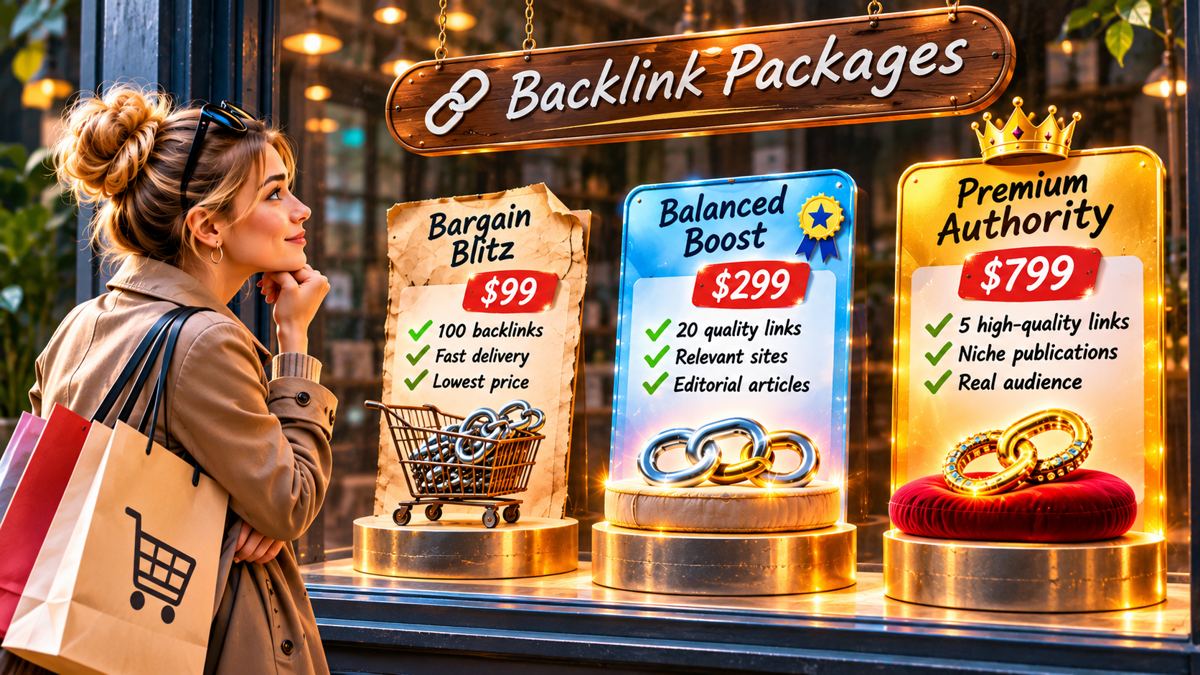
Emma Collins had been running her online home décor store for almost three years. She sold handmade candles, ceramic vases, decorative cushions, and small furniture accessories. Her customers loved the products, and the reviews were encouraging.
There was just one problem.
Not enough people were finding her website.
Every month, Emma watched competitors appear above her in Google search results. Some had larger advertising budgets. Others seemed to attract customers without spending much on paid campaigns.
One afternoon, while researching SEO services, she discovered an advertisement that immediately caught her attention.
100 BACKLINKS FOR JUST $99!
“That's less than a dollar per link,” she said, leaning closer to her laptop. “Why would anyone pay hundreds for a single backlink?”
She clicked the offer.
What followed became an unexpected lesson about the real cost of backlinks, the difference between quantity and quality, and why the cheapest marketing decision isn't always the smartest one.
The Temptation: 100 Backlinks for Less Than $100
The sales page looked convincing.
It promised fast delivery, hundreds of links, and an impressive-looking SEO report.
Emma had previously received an agency quotation of $600 for several editorial publications.
Compared with that offer, $99 seemed almost irresistible.
She contacted the seller.
“Will these backlinks help my website rank higher?”
The representative responded enthusiastically.
“Our package is designed to support your SEO campaign. You'll receive 100 backlinks within seven days.”
Emma asked where the links would appear.
“On different websites and online platforms,” came the reply.
It wasn't particularly specific, but Emma was focused on the number.
One hundred backlinks sounded substantial.
She placed the order.
At that moment, she believed she had discovered a clever way to reduce her backlink price without sacrificing results.
Seven Days Later: The Report Looked Impressive
Exactly one week later, an email arrived.
“Your link building campaign has been completed.”
Attached was a spreadsheet containing 100 URLs.
Emma opened the document and smiled.
There they were.
One hundred links pointing toward her online store.
Some appeared in short articles. Others were located on profile pages, directories, and websites she had never heard of.
The report looked professional enough, and every row contained a URL.
“Finally,” she thought. “Something that might help us compete.”
She saved the spreadsheet and returned to managing her store.
For the next few weeks, she checked her analytics almost every morning.
She expected more visitors.
Perhaps a few additional orders.
Maybe even a noticeable improvement in Google rankings.
But the results were disappointing.
Thirty Days Later: Where Were the Customers?
A month passed.
Emma's organic traffic remained broadly unchanged.
Her main product categories showed no meaningful improvement in search visibility.
More importantly, the new backlinks had generated almost no identifiable referral visits.
She opened the spreadsheet again.
This time, instead of counting the links, she started examining them.
One appeared on a website containing hundreds of unrelated articles.
Another was buried inside a user profile.
Several were placed on pages with little original content.
A few URLs were no longer accessible.
“Wait a minute,” Emma whispered. “Who actually reads these websites?”
That question changed everything.
She had purchased 100 backlinks, but she had never seriously considered whether the publications could reach potential customers.
The advertised cost of backlinks had been low.
The actual marketing value was far less obvious.
A Conversation That Changed Her Perspective
Emma contacted her friend Daniel, who worked as a freelance digital marketing consultant.
“I bought 100 backlinks for $99,” she explained. “But nothing seems to have happened.”
Daniel asked to see the report.
He examined several URLs before responding.
“Emma, why did you choose these websites?”
“Because the package included 100 links.”
“But are any of them about home decoration?”
She hesitated.
“Not really.”
“Do they have readers interested in your products?”
“I honestly don't know.”
Daniel leaned back.
“Then you didn't buy a marketing strategy. You bought a number on a spreadsheet.”
The comment was uncomfortable, but Emma understood his point.
She had evaluated the offer based entirely on link building prices, without investigating the websites, audiences, or content.
Daniel also explained that paid links created primarily to manipulate search rankings can violate Google's spam policies. Sponsored links should be appropriately qualified, and no seller can legitimately guarantee ranking improvements simply by delivering a certain number of backlinks.
Her campaign hadn't demonstrated a Google penalty, nor could she conclude that the links had caused any ranking changes.
What she could see was that the purchased placements had produced little measurable business value.
The Second Offer: Only Five Publications for $350
A week later, Emma received another proposal.
This time, the provider offered five sponsored editorial publications for $350.
The price initially seemed excessive.
“Seventy dollars per article?” she asked. “I paid less than that for almost seventy links!”
But she remembered Daniel's advice.
Instead of immediately rejecting the offer, she examined the publishers.
One website focused on interior decoration.
Another published practical articles about sustainable living.
A third specialized in handmade products and small independent brands.
The remaining two covered home organization and lifestyle topics.
These websites were much closer to her business.
Emma reviewed their existing articles, estimated traffic, editorial quality, and publication requirements.
She also checked the sponsored content conditions.
The difference was obvious.
These weren't simply places where a link could be inserted. They were publications with topics that matched her products.
She decided to test the offer.
Five Articles, Five Different Customer Questions
Emma didn't want five nearly identical promotional articles.
Instead, she developed topics that potential customers might genuinely find useful.
The first article explained how to choose decorative candles for different rooms.
The second explored sustainable materials in home accessories.
Another discussed combining handmade ceramics with modern interior design.
The fourth focused on decorating small apartments without creating clutter.
The final article examined how thoughtful home accessories could change the atmosphere of a living space.
Each publication contained useful information and a relevant reference to Emma's business.
The articles were clearly presented as sponsored content where appropriate.
Emma also made sure the landing pages on her store matched the subjects being discussed.
She wanted visitors arriving from the publications to find products related to what they had just read.
This time, her decision was based on audience relevance rather than the lowest cost of backlinks.
The Unexpected Results
Six weeks after the second campaign began, Emma reviewed her analytics.
The numbers surprised her.
Her original 100-link package had generated only four identifiable referral visits during its first month.
The five specialized publications had generated 146 referral visits over six weeks.
Even more interestingly, eight visitors from the second campaign had completed purchases.
The average order value was approximately $68.
That represented $544 in attributed revenue.
Emma stared at the screen.
“Five articles brought us more customers than a hundred links?”
Daniel smiled.
“Now you're measuring something that actually matters.”
The figures were part of a fictional example, not real campaign data. They illustrate how different publication strategies might perform, rather than predict results for other businesses.
Emma also understood that $544 in revenue did not mean $544 in profit. Product costs, shipping, transaction fees, and the publication expense still needed to be considered.
Nevertheless, the campaign had generated identifiable customer activity.
That was something the first package had failed to demonstrate.
The Real Cost of Backlinks: A Surprising Calculation
Emma decided to compare both campaigns.
The first had cost $99 for 100 backlinks.
The second had cost $350 for five editorial publications.
On a cost-per-link basis, the first package appeared dramatically cheaper.
But the referral traffic told a different story.
The first campaign had cost approximately $24.75 per recorded referral visit during its initial observation period.
The second had cost approximately $2.40 per referral visit.
The observation periods were different, so this was not a controlled comparison. The second campaign also had more time to accumulate visits.
Still, the contrast was substantial.
Emma had initially assumed that a low backlink price meant better value.
Now she realized that the amount paid for each link was only one part of the calculation.
A publication could also provide brand exposure, relevant visitors, and potential sales.
These benefits were not guaranteed, but they were measurable.
Why 100 Backlinks Didn't Automatically Improve Rankings
Emma still had one question.
“If the first campaign gave me 100 backlinks, shouldn't that have helped my Google rankings?”
Daniel explained that search engines do not simply count links and reward websites with the largest totals.
Links differ in context, relevance, implementation, and how search engines interpret them.
Some links may be ignored or assigned little ranking value. Paid links intended to manipulate rankings can also create policy risks.
Furthermore, ranking changes depend on many other factors, including content relevance, technical accessibility, competition, and the quality of the website itself.
A backlink report cannot establish that a campaign will improve search positions.
The same applies to more expensive publications.
The five editorial articles might provide useful exposure, but Emma could not assume they would produce a particular ranking improvement.
That distinction helped her approach future campaigns with more realistic expectations.
The Twist: The Cheapest Link Wasn't Her Worst Purchase
Several months later, Emma reviewed her external marketing activities again.
One of the inexpensive backlinks had unexpectedly sent a small number of relevant visitors to her website.
It appeared on a modest home organization blog included within the original package.
Unlike many of the other pages, this website had content closely related to her products.
A visitor from that article had even subscribed to her newsletter.
Emma laughed when she discovered it.
“So the cheap campaign wasn't completely useless after all.”
Daniel agreed.
“Exactly. Price doesn't determine quality. Relevance matters.”
This was the final lesson Emma needed.
Her mistake had not been purchasing inexpensive backlinks.
It had been assuming that every backlink was equally valuable and that quantity alone would produce results.
A $10 publication could be worthwhile under the right circumstances.
A $500 placement could be a poor investment if the audience was irrelevant.
The cost of backlinks made sense only when evaluated alongside the actual publication opportunity.
What Emma Would Do Differently Next Time
Emma eventually developed a simple process for evaluating future offers.
Before purchasing any external publication, she would ask:
• Does the website cover subjects related to my products?
• Could its readers become potential customers?
• Is the article informative and appropriate for the publisher?
• Are publication fees and conditions transparent?
• Does the content provide value beyond the existence of a backlink?
• Can I measure referral traffic or other useful outcomes?
She also stopped treating third-party authority scores as guarantees of quality.
Metrics such as Domain Rating and Domain Authority could help her compare websites, but they were not official Google ranking factors.
More importantly, she began allocating money toward content that answered real customer questions.
Instead of purchasing links simply because they were inexpensive, she wanted publications that made sense for her brand.
Final Thoughts: The $99 Lesson That Changed Her Marketing Strategy
Emma's experience began with a tempting offer.
One hundred backlinks for $99 seemed like an extraordinary bargain.
But the initial campaign demonstrated that an impressive number of links could produce very little measurable audience engagement.
Her second experiment involved fewer publications and a higher upfront expense.
Yet the articles reached more relevant readers and generated identifiable purchases.
The unexpected discovery was that neither price nor quantity alone determined the value of a publication.
Understanding the cost of backlinks means looking beyond the invoice.
It means evaluating the publisher, audience, content, commercial objectives, and risks associated with the placement.
Cheap backlinks are not automatically worthless. Expensive backlinks are not automatically valuable.
The difference lies in what the publication actually offers.
And for Emma, the most important change wasn't the number of links pointing to her store.
It was finally understanding why someone would want to click them.